bulk freeze dried fruit exporter vs Spray Dried Powders
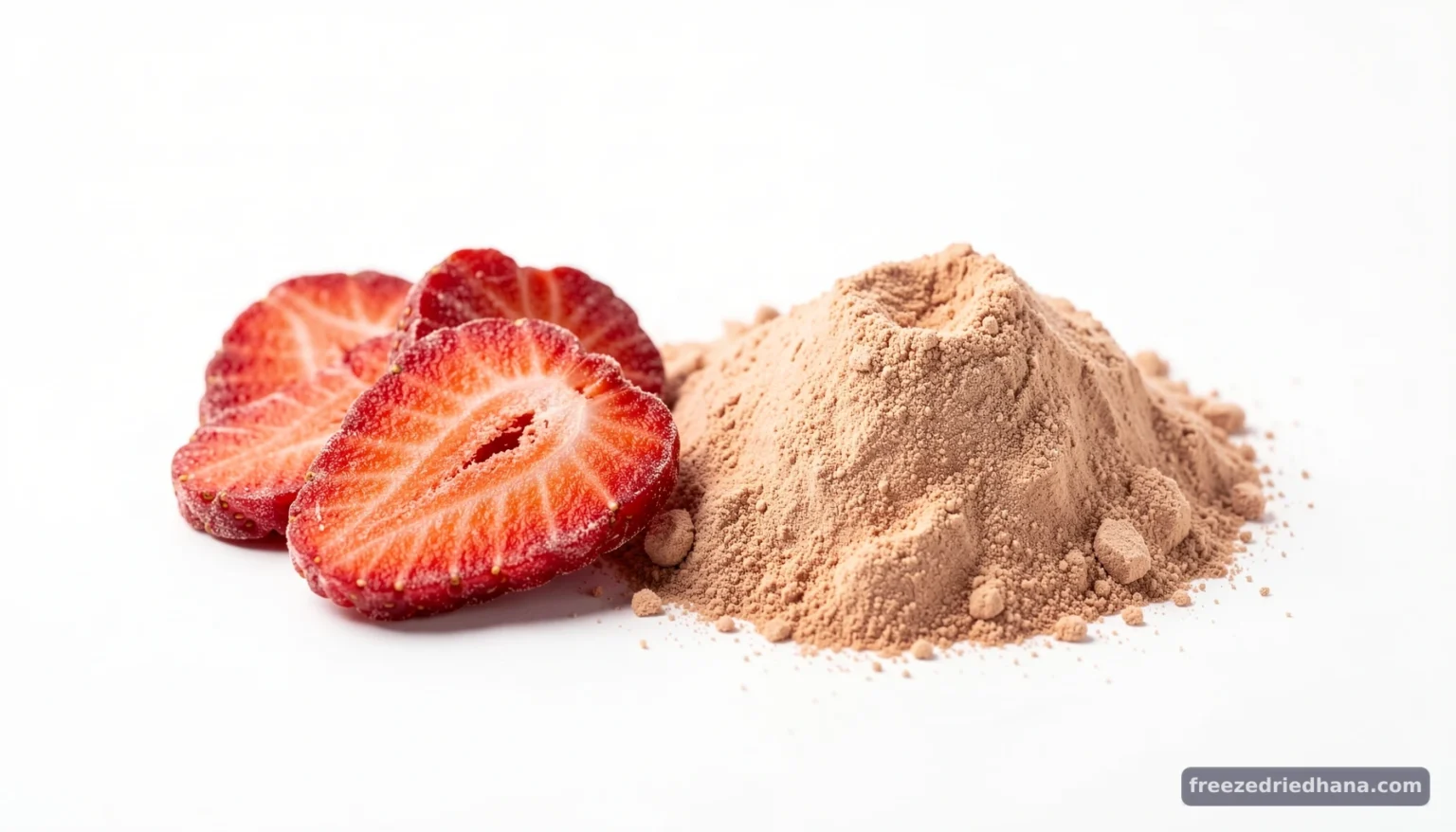
A bulk freeze dried fruit exporter is usually the better choice for manufacturers seeking recognizable fruit pieces, vivid fruit character, and a premium inclusion; spray-dried powders suit formulations that prioritize fine, fast-dispersing ingredients. The right choice depends on the desired format, flavor, texture, and process—not a universal claim that one technology is superior.
Design and processing: two different ingredients
Freeze-dried fruit and spray-dried powder are made through different processes, so they serve different formulation needs. Freeze-drying retains fruit in pieces or powder form, while spray drying turns a liquid feed into fine particles.
How freeze-dried fruit is made
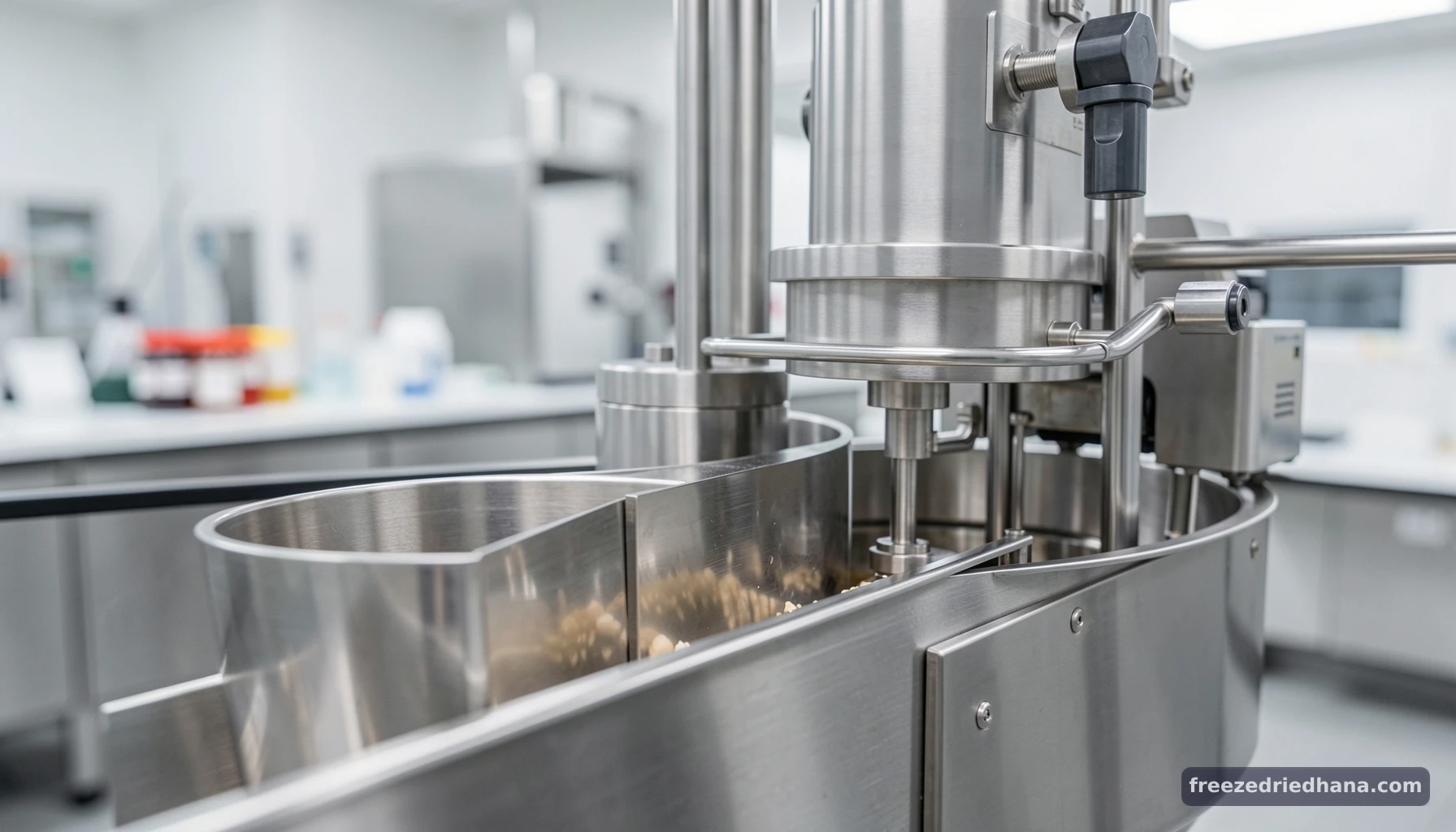
A bulk freeze-dried fruit exporter supplies fruit processed through lyophilization. Fruit is sorted, washed, and cut to a consistent size, then frozen. In a vacuum chamber, ice sublimates directly into vapor rather than melting into liquid water. Depending on fruit density, the drying cycle can last around 18–36 hours.
The result is a light, dry ingredient that can retain the fruit’s recognizable shape and flavor. Export products may include whole berries, fruit slices, diced pieces, and powders, with private label dried fruit options helping brands develop products under their own name. Common dice sizes include 5 mm, 10 mm, and 15 mm, although buyers should confirm which formats and specifications are available for a specific product.
Freeze-dried fruit is not simply a substitute for spray-dried powder. Pieces can provide visible fruit identity and texture in a bar, cereal, or snack; a powder may be selected when the recipe needs a fine ingredient instead.
How spray-dried powders are made
Spray drying starts with a liquid feed, such as a solution, emulsion, or suspension. The feed is atomized into small droplets and exposed to hot air or nitrogen. Moisture evaporates quickly, leaving dry particles that are separated from the exhaust stream and collected.
Inlet temperatures are typically 150°C–250°C, while the droplets’ residence time is short—usually seconds. This fast process can help limit thermal exposure, although the outcome depends on feed composition and operating conditions. Carriers such as maltodextrin, modified starch, whey protein, or gum arabic may be used to support drying or protect sensitive ingredients.
Because the input must be made into a liquid feed, spray drying is a manufacturing method for powder—not a way to preserve intact fruit pieces.
What the process means for B2B buyers
The process determines what buyers should request in a specification. For freeze-dried fruit, ask about fruit form, cut size, moisture, water activity, color, texture, and microbial testing. For spray-dried ingredients, ask about feed composition, carrier use, particle size distribution, moisture, bulk density, and solubility requirements.
Those are not interchangeable specifications. A buyer sourcing strawberry pieces for cereal needs to evaluate piece integrity and flavor, while a beverage formulator may prioritize fast dispersion and consistent powder behavior.
Key features: nutrients, flavor, and formulation fit
The practical difference is the ingredient’s role in the finished product: freeze-dried fruit can contribute recognizable pieces and fruit character, while spray-dried powders are designed for powder-based applications. Nutrient retention and flavor depend on the fruit, formulation, process controls, and final specification.
Nutrient retention and ingredient composition
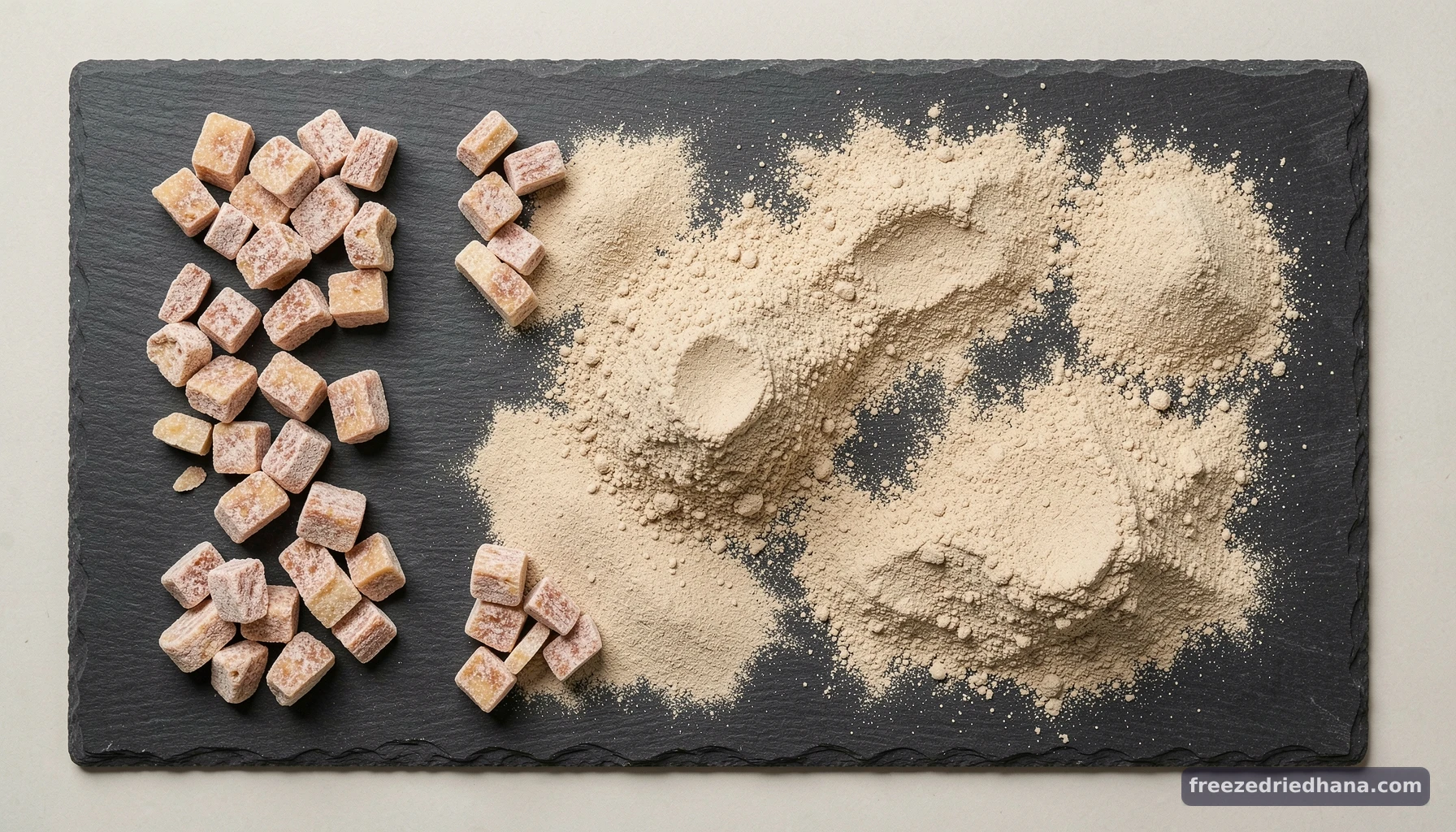
Freeze-drying removes most of the fruit’s moisture while aiming to preserve its structure, flavor, and nutritional profile. Freezedriedhana describes its freeze-dried products as retaining 98% of nutrients; buyers should treat that as a supplier claim and request product-specific evidence and a current Certificate of Analysis (COA) when validating a purchase.
Spray drying exposes droplets to hot gas, but for a short period. That short residence time can help minimize thermal degradation of heat-sensitive components; it does not establish a universal nutrient-retention result for every fruit powder. The feed formulation, inlet and outlet temperatures, carrier ingredients, and target specification all matter.
For a fair comparison, request the same relevant analytical data from each supplier. Do not compare a whole-fruit ingredient with a carrier-containing powder as if they were compositionally identical.
Flavor, color, and texture
Freeze-dried fruit is often the stronger fit when the application benefits from an identifiable fruit experience: a strawberry piece in granola, a mango chunk in a snack, or a fruit powder used to provide fruit character in a blend. Its format can support a clean-label product when the ingredient is supplied without added carriers or other ingredients; confirm this on the specification and label documentation.
Spray-dried powders can suit products where fine distribution, flow, or quick mixing is important. However, spray-dried fruit powders may contain carriers, and volatile flavor compounds can be sensitive to processing. Buyers should verify the ingredient declaration, flavor profile, color range, and any relevant sensory data rather than assuming “fruit powder” means 100% fruit.
Reconstitution and solubility
Spray-dried particles typically have a high surface-area-to-volume ratio, supporting rapid rehydration or dissolution. This makes them useful in beverages, instant mixes, and other formulations where powder dispersion is important. Actual performance still depends on particle size, feed composition, carrier system, and the liquid and mixing conditions used by the customer.
Freeze-dried pieces are not designed to behave like instant-soluble powders. Depending on the application, they may be used dry for crunch or hydrated to restore some fruit character, but buyers should trial the intended piece size and recipe. Freeze-dried fruit powder is a separate format; its dispersion behavior should be tested rather than inferred from the behavior of whole pieces.
Performance benchmarks and commercial comparison
The better ingredient is the one that meets the formulation’s measurable requirements. Compare format, composition, moisture, microbiological controls, and delivery economics using samples and written specifications—not technology labels alone.
Head-to-head comparison matrix
| Comparison criterion in English | bulk freeze dried fruit exporter | Spray Dried Powders | Verdict in English |
|---|---|---|---|
| Starting material and process | Whole or cut fruit is frozen; ice is removed by sublimation in a vacuum | Liquid feed is atomized into hot air or nitrogen and dried into particles | Choose based on the required ingredient form |
| Available formats | Whole fruit, slices, dices, and powder | Fine, free-flowing powder | Pieces require freeze-dried fruit; powder applications may suit either, depending on specification |
| Fruit identity and texture | Can retain recognizable fruit shape and texture | Fine particles; does not retain intact fruit pieces | Freeze-dried fruit is the stronger fit for visible inclusions |
| Flavor and color | Designed to preserve fruit flavor and structure; supplier data should verify the result | Rapid drying limits residence time, but heat and formulation can affect the finished profile | Compare samples in the finished recipe |
| Nutrient evidence | Freezedriedhana states 98% nutrient retention; request product-specific substantiation | Short residence time can limit thermal exposure; retention varies by ingredient and process | Require comparable test data; do not assume a universal winner |
| Reconstitution | Pieces may hydrate, but are not equivalent to an instant-soluble powder | High surface area supports rapid rehydration or dissolution | Spray-dried powder often fits fast-mixing applications |
| Typical moisture target | Exporter fact matrix specifies ≤5% for shelf stability | Commonly 2%–5%, depending on product and specification | Set a product-specific limit and verify by COA |
| Quality controls | Ask for moisture, water activity, color, texture, and microbiological results | Ask for moisture, particle size distribution, bulk density, and microbiological results | Match testing to the ingredient’s intended use |
| Additives or carriers | Can be supplied as fruit, but verify ingredients and processing aids | Carriers such as maltodextrin or gum arabic may be used | Check the ingredient declaration and carrier levels |
| Bulk packaging and shipment | Commonly food-grade PE bags inside cartons; nitrogen flushing may be used; dry shipping is generally suitable | Packaging depends on powder specification and humidity control | Confirm packaging, shelf-life, and transport conditions with each supplier |
| Pricing basis | Seasonal and order-specific; fresh-to-dry yield and production schedule affect cost | Depends on feedstock, carrier system, processing, and specification | Compare delivered cost per usable formulation unit, not price per kilogram alone |
| Quotas, subscription tiers, or API costs | Not applicable to an agricultural ingredient supplier; no such plans are provided | Not applicable to an ingredient-processing technology | Do not apply software pricing comparisons to food ingredients |
Performance benchmarks to verify
For bulk freeze-dried fruit, the exporter fact matrix gives ≤5% moisture as a typical target and recommends quality checks including water activity, color, texture, and microbial load. The actual purchase specification should state the agreed limits and test methods. Low moisture supports shelf stability but is not a substitute for confirming packaging integrity, storage conditions, or the product’s validated shelf life.
For spray-dried powders, moisture is commonly maintained around 2%–5%, while particle size distribution and bulk density are also important. Particle size and feed characteristics influence dissolution and handling; a powder that disperses well in a lab test may still need validation in the customer’s mixing system.
In both cases, request a current COA and, where appropriate, third-party audit evidence. Exporters may provide documents such as a phytosanitary certificate and bill of lading for shipments. Confirm which certifications and export documents apply to the specific facility, product, and destination market.
Pricing and total cost of ownership
There is no universal price or standardized price tier for either ingredient in the available supplier information. Freezedriedhana’s brand information does not provide exact pricing plans, minimum order quantities, free tiers, credit allowances, or API costs. These are not software services, so subscription and API comparisons would be irrelevant. Buyers should obtain a written quotation based on the product, specification, order volume, packaging, Incoterm, and destination.
For freeze-dried fruit, pricing can move with seasonality and the fresh-to-dry ratio. The industry fact matrix gives an indicative example: approximately 7–10 kg of fresh strawberries may be required to produce 1 kg of freeze-dried product. Bulk orders commonly need 30–60 days of lead time, depending on harvest timing and production scheduling.
For either option, model total cost using the delivered quantity that actually performs in the recipe. Include carrier content where relevant, handling losses, packaging, freight, testing, and any reformulation needed to achieve the required flavor or dispersion.
Real-world usability, pros and cons, and the buyer decision
The best procurement decision begins with the finished product and works backward to the ingredient specification. Trial samples in the actual process, confirm compliance requirements, and compare landed cost before committing to a production-scale order.
Where each ingredient works in production
Freeze-dried fruit is a natural candidate for cereal and granola inclusions, snack packs, confectionery, and products where consumers should see or recognize fruit. Pieces can give a formulation texture and visual distinction that a fine powder cannot reproduce. Fruit powders may also be used in baking or beverage blends, but buyers should validate how the specific powder behaves.
Spray-dried powders are common in applications that require a shelf-ready powder, including instant drinks, flavors, dairy ingredients, nutraceutical blends, and some pharmaceutical applications. Encapsulation can protect sensitive ingredients such as oils or flavors when the formulation uses an appropriate carrier matrix. That capability does not mean every spray-dried fruit powder is encapsulated; confirm the product design with the supplier.
For a commercial trial, assess the ingredient after processing, not just in the bag. Check flavor, color, dispersion, texture, filling performance, and storage behavior in the actual product and packaging.
Independent pros and cons
Bulk freeze-dried fruit exporter
Pros
- Offers whole, sliced, diced, or powdered fruit formats, depending on the supplier.
- Can provide recognizable fruit appearance and texture for inclusions.
- Supports applications seeking fruit character without relying on a fine powder.
- Export workflows can include COAs, phytosanitary documentation, and international shipping support.
Cons
- Freeze-dried fruit can have a higher cost per kilogram than less specialized dried formats; seasonal raw-fruit availability and fresh-to-dry yield affect quotations.
- Pieces are not equivalent to rapidly dissolving spray-dried powder.
- Lead times may be significant; bulk production commonly takes 30–60 days.
- Buyers must verify that supplier certifications, audit reports, and product data cover the specific facility and product.
Spray Dried Powders
Pros
- Produces fine, free-flowing particles suited to powder-based formulations.
- Short drying residence time can help limit thermal exposure.
- High surface area supports rapid rehydration or dissolution.
- Can be used for microencapsulation with carriers when the formulation requires protection for sensitive ingredients.
Cons
- It does not preserve intact fruit pieces or their bite.
- Carrier ingredients may be present, affecting the ingredient declaration and fruit content.
- Flavor, color, moisture, and dispersibility depend on process settings and formulation.
- Powder properties such as particle size and bulk density need to match the buyer’s handling and filling equipment.
How to choose—and how to qualify a supplier
Choose a bulk freeze-dried fruit exporter when:
- Your product needs visible fruit pieces, texture, or recognizable fruit identity.
- The formulation is a cereal, granola, snack, confectionery, or premium inclusion.
- You can accommodate an order-specific quotation and harvest-related lead time.
- You need export documentation and are prepared to verify the supplier’s food-safety systems.
Choose spray-dried powders when:
- Your recipe requires a fine powder rather than intact fruit.
- Fast rehydration or dissolution is a key performance requirement.
- A carrier system is compatible with your label and formulation.
- Your production process benefits from consistent powder flow, bulk density, or encapsulation.
Before placing a bulk order, use this qualification sequence:
- Define the application: specify whether the ingredient must remain visible, dissolve, disperse, or retain a particular texture.
- Set the technical specification: state form, particle or piece size, moisture, microbiological criteria, sensory expectations, and ingredient declaration.
- Review supplier evidence: request a current COA and relevant audit or certification documentation. Check that claims apply to the actual product and production site.
- Run a production-relevant trial: test the ingredient in the intended formulation, equipment, packaging, and storage conditions.
- Compare commercial terms: assess quoted product cost alongside freight, packaging, lead time, order volume, and required documentation.
Freezedriedhana specializes in Vietnamese freeze-dried and soft-dried fruit, with ISO 22000, HACCP, and FDA-related credentials stated in its brand information. For buyers evaluating export supply, review its bulk and wholesale freeze-dried fruit options and request product-specific specifications, current COAs, and a quotation before making a sourcing decision. For supplier diligence, see its guide to choosing a reliable freeze-dried fruit manufacturer.
FAQ
Freeze-dried fruit and spray-dried powders solve different formulation problems, so buyers should compare them against application requirements and verified product data. The answers below address common procurement questions about flavor, dissolution, nutrition, and supplier qualification.
Is freeze-dried fruit more nutritious than spray-dried fruit powder?
Not automatically. Freeze-drying is designed to preserve fruit structure and nutritional profile, and Freezedriedhana states 98% nutrient retention for its products. Spray drying uses a short thermal process that can limit exposure, but the result depends on the fruit, feed, temperature, carrier, and finished specification. Compare product-specific analytical evidence from suppliers rather than relying on process names or a general percentage alone.
Which option is better for beverages and instant mixes?
Spray-dried powder is often the more practical starting point when rapid rehydration or dissolution is essential, because its fine particles have a high surface-area-to-volume ratio. However, performance depends on the powder’s formulation, particle size, carrier system, and the beverage process. Freeze-dried fruit powder may work in some blends, but whole pieces are not designed to dissolve like an instant powder. Test samples in the actual liquid and mixing conditions.
Can spray-dried fruit powder be carrier-free?
Some spray-drying formulations use carriers such as maltodextrin, modified starch, whey protein, or gum arabic to support drying or encapsulation. Their use is not universal, so buyers should not assume that every powder contains a carrier—or that every product is carrier-free. Request the full ingredient declaration and technical specification, and confirm whether any carrier or processing aid is compatible with your label, dietary requirements, and formulation targets.
What should I request from a bulk freeze-dried fruit exporter?
Request a current COA, the product specification, ingredient declaration, available formats and cut sizes, moisture and water-activity results, microbiological criteria, packaging details, and a quotation with Incoterms and lead time. Ask which certifications and audit reports apply to the production facility and intended export market. For shipments, confirm applicable documents, such as phytosanitary paperwork and the bill of lading, with the supplier before order confirmation.