Choosing a Reliable Freeze Dried Fruit Manufacturer
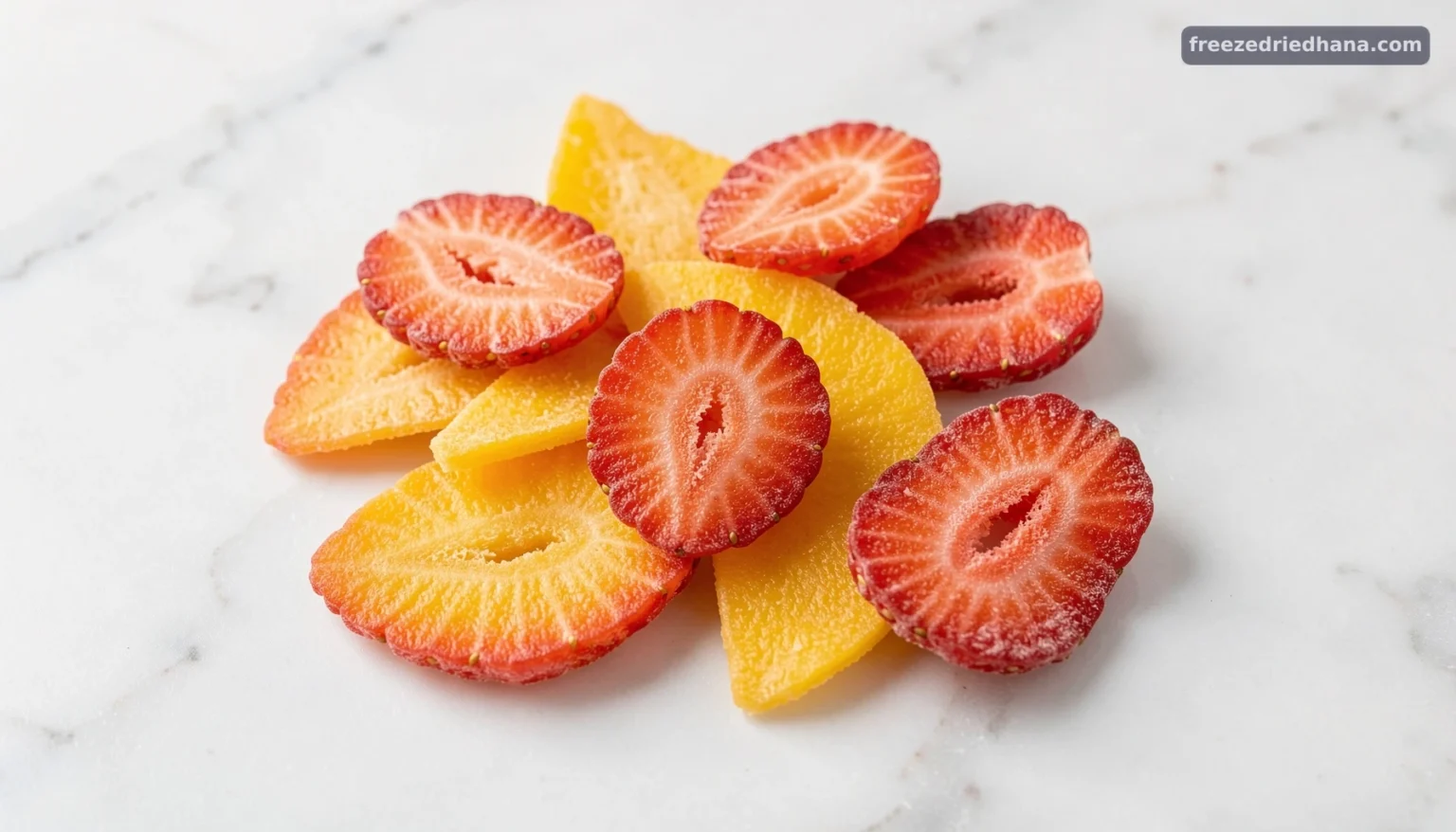
A reliable freeze dried fruit manufacturer combines consistent processing, clear product specifications, food-safety documentation, and export support to help brands source shelf-stable fruit with confidence. Freezedriedhana manufactures and exports freeze-dried fruits, soft-dried fruits, and fruit powders from Vietnam, offering brands a partner for private-label dried fruit production in Vietnam. For buyers, the right partner is a wholesale freeze-dried fruit supplier whose product format, compliance documents, packaging services, and shipping options fit the intended application and market.
What a Freeze Dried Fruit Manufacturer Does
A freeze-dried fruit manufacturer turns harvested fruit into a shelf-stable ingredient or snack using vacuum freeze-drying technology. Buyers should assess not just the finished product, but also whether the manufacturer can explain its process, product specifications, food-safety credentials, and route from inquiry to export; a comparison of freeze-dried fruit and spray-dried powders can help clarify which format fits their needs.

Freeze-dried fruit versus other dried formats
Freeze-drying uses vacuum technology to remove moisture from fruit. Freezedriedhana states that its freeze-dried fruit retains 98% of original nutrients and has a 24-month shelf life. Those figures are the manufacturer’s stated product specifications; buyers should confirm the relevant specification sheet, storage conditions, and product details for the item they plan to purchase.
Freeze-dried fruit is different from soft-dried fruit. Freezedriedhana uses heat-drying for its soft-dried products, which are focused on texture and natural sweetness for retail markets. These formats serve different purposes: freeze-dried pieces may suit shelf-stable snack lines or recipes that call for a light, crisp fruit component, while soft-dried fruit may better fit products where a softer bite and natural sweetness are desired.
Fruit powders provide another option for food and beverage applications. The company offers cold-dried vegetable powders and freeze-dried dragon fruit powder, described as 100% water-soluble for industrial food applications. Buyers should identify the specific powder, its intended use, and its formulation requirements before requesting a quote.
Why manufacturing capability matters to B2B buyers
A manufacturer’s capabilities affect more than the product itself. Retail brands, food and beverage companies, distributors, and wholesalers may need different formats, packaging, order volumes, and delivery arrangements. A supplier offering multiple product categories can help a buyer compare formats through one procurement conversation, but each product still needs to be assessed against its own application and specifications.
Freezedriedhana’s stated B2B services include OEM and private-label production, as well as FCL and LCL shipping options. These services can support brands that want to expand a product range without investing in their own factory, and buyers whose order size does not justify a full container can discuss less-than-container-load shipping.
The company describes a global supply network spanning the United States, European Union, and Asia. That reach is relevant to international sourcing, but it does not replace market-specific import checks. Buyers remain responsible for confirming that the product, documentation, packaging, and shipment meet requirements in the destination market.
How to Compare a Freeze Dried Fruit Manufacturer
Compare suppliers against the same practical criteria: product format, stated specifications, safety documentation, customization, and shipping. A structured comparison helps procurement teams distinguish between what is confirmed, what requires verification, and what is simply a good fit for their product concept.
Compare product formats and stated specifications
The table below summarizes the product categories and capabilities Freezedriedhana identifies. It is a starting point for supplier evaluation, not a substitute for current product documents or a buyer’s own import review.
| Category | Stated process or specification | Potential B2B fit |
|---|---|---|
| Freeze-dried fruits | Vacuum freeze-drying; manufacturer states 98% nutrient retention and a 24-month shelf life | Shelf-stable snack products, retail lines, and fruit components |
| Soft-dried fruits | Heat-dried; designed around texture and natural sweetness | Retail products where a softer fruit texture is preferred |
| Vegetable powders | Cold-dried; included in the company’s powder range | Food and beverage formulations, subject to product-specific review |
| Dragon fruit powder | Freeze-dried; described as 100% water-soluble for industrial applications | Industrial food applications such as beverages, subject to formulation testing |
| Private label and OEM | Services offered for international brands | Brand expansion using an external manufacturing partner |
| FCL and LCL shipping | Both full-container and less-than-container-load options offered | Shipment planning based on order size and destination |
Before approving a product, ask for the exact format and specification relevant to the intended application. For example, a snack brand should assess the fruit format and packaging it needs, while a beverage developer should verify the particular powder’s suitability in its formulation. Avoid treating specifications for one category as though they automatically apply to every product.
Verify compliance and export readiness
Freezedriedhana identifies ISO 22000 and HACCP among its quality and food-safety credentials and states that it is FDA Registered. These details help buyers frame due diligence, but they are not a substitute for checking current documents, their scope, or destination-specific import rules. FDA registration should not be described as FDA approval.
Ask the supplier to share relevant documentation for review, then confirm that the product and shipment align with the buyer’s regulatory and quality requirements. The required review may vary by product and destination. A US, EU, or Asian distributor should not assume that a general certification statement alone establishes import eligibility for every product or use.
Compare suppliers using questions such as:
- Can the supplier provide current food-safety documentation for review?
- Are the product format and claims stated specifically for the item being quoted?
- Can the supplier discuss the buyer’s packaging, OEM, or private-label needs?
- Are FCL and LCL options available for the proposed destination and volume?
- What product details and order assumptions will be recorded in the quote?
A dependable supplier should be able to discuss these points clearly. Buyers should document responses alongside the product specification and the commercial terms before placing an order.
How to Source from Inquiry to Export
A practical procurement process starts with a clear brief and ends with a documented shipment plan. Freezedriedhana’s stated workflow moves from a buyer inquiry through consultation, compliance review, logistics planning, production, and export.
Step 1: Define the product and buying requirements
Begin by describing the use case and the product format you want to evaluate. Is the requirement for freeze-dried fruit, soft-dried fruit, vegetable powder, or freeze-dried dragon fruit powder? Include the intended application, target market, packaging needs, and estimated order volume in the initial inquiry.
Potential B2B buyers initiate contact through the website’s Request Quote portal. A precise request helps the supplier assess whether the proposed format and service match the project. If the product concept is still flexible, identify the desired texture or application rather than treating all dried fruit formats as interchangeable.
Buyers exploring available categories can review Freezedriedhana’s fruit and dried-fruit products as part of preparing an inquiry. Use that review to develop questions; confirm the specifications and availability of the specific product directly with the supplier.
Steps 2–5: Confirm compliance, logistics, and production
After the inquiry, Freezedriedhana’s team assesses volume requirements, product specifications, and packaging needs, including private-label or OEM requests. Buyers should use this consultation to clarify what is included in the quote and to confirm that both parties are discussing the same product format and market requirements.
The next steps are:
- Review compliance documents. Request and review relevant ISO 22000, HACCP, and FDA registration documentation. Check the documents against your organization’s requirements and the destination market.
- Plan shipping. Discuss whether FCL or LCL is appropriate based on the order size and destination. Confirm shipment assumptions with the supplier before finalizing the purchase.
- Confirm production details. Ensure the product type, packaging request, and agreed commercial details are documented before production.
- Coordinate export. Align on the international distribution plan and the information needed for your receiving facility.
This sequence is useful for both a first purchase and a product-line expansion. For a new retail snack, the buyer may focus on the freeze-dried or soft-dried format and private-label requirements. For a food manufacturer, the initial consultation may instead center on powder type and intended formulation.
Practical Tips, Pitfalls, and Buyer Scenarios
The most common sourcing problems arise when buyers assume that a product category, certification, or shipping option automatically answers every project question. Prevent them by requesting product-specific information, separating stated facts from assumptions, and documenting decisions before production.
Avoid specification and compliance assumptions
A stated shelf life or nutrient-retention figure should be checked against the exact product being sourced. Freezedriedhana states that its freeze-dried fruits have a 24-month shelf life and retain 98% of original nutrients; buyers should confirm the applicability of those specifications to their chosen item and review any storage or handling information supplied with it.
Likewise, a general description of “fruit powder” is not enough for formulation work. Clarify whether the item is a cold-dried vegetable powder or freeze-dried dragon fruit powder, and verify the product’s suitability for the intended process. Although the company describes its powders as 100% water-soluble for industrial food applications, product developers should still evaluate the specific ingredient in their own formulation.
Common pitfalls and practical responses include:
- Treating all dried fruit as equivalent: Specify freeze-dried or soft-dried fruit according to the intended texture and use.
- Relying on a certification label alone: Review the current documentation and confirm its relevance to your procurement requirements.
- Assuming a powder fits every recipe: Request details for the specific powder and assess it in the application.
- Leaving packaging until late: Include OEM or private-label needs in the initial consultation.
- Choosing shipping without comparing order size: Discuss FCL and LCL options against the proposed volume and destination.
Apply the process to real B2B use cases
A retail brand planning a shelf-stable fruit snack can start by comparing freeze-dried fruit with soft-dried fruit. The decision should reflect the desired eating experience: the former is produced using vacuum freeze-drying, while the latter is heat-dried with a focus on texture and natural sweetness. If the brand needs its own packaging, it can raise private-label or OEM requirements during consultation rather than after product decisions are made.
A beverage or food manufacturer may be more interested in fruit powder. In that case, the buyer should specify the intended formulation and ask about the relevant powder category. The supplier describes its freeze-dried dragon fruit powder as 100% water-soluble for industrial food applications; the buyer should verify the specification and conduct its own product-development assessment before scaling.
A distributor or wholesaler may prioritize shipment size and export planning. Discussing FCL and LCL options early can help align the order plan with the destination and estimated volume. In each scenario, the useful lesson is the same: convert the commercial idea into a written brief, validate product and compliance details, and confirm logistics before production begins.
2026 Outlook and Expert Perspective
In 2026, international buyers can make more resilient sourcing decisions by evaluating the complete supplier relationship: product fit, verifiable food-safety documentation, customization, and export logistics. Freezedriedhana’s Vietnam-based manufacturing and export model brings these considerations together for buyers in retail, food manufacturing, and distribution.
What buyers should prioritize in 2026
There is no single universal performance benchmark that determines whether a freeze-dried fruit supplier is right for every buyer. Instead, use measurable criteria relevant to the purchase: the exact product specification, the stated shelf life where applicable, documentation review, packaging requirements, order volume, and shipping plan. For Freezedriedhana, the stated figures include 24 months of shelf life and 98% nutrient retention for freeze-dried fruits; buyers should confirm their relevance to the selected item rather than generalize them across the full range.
A 2026 procurement review can use these questions:
- Does the supplier offer the product format the application requires?
- Are the product claims and specifications confirmed for the quoted item?
- Can the supplier support the intended OEM or private-label packaging?
- Has the buyer reviewed applicable ISO 22000, HACCP, and FDA registration documentation?
- Are the shipment method and destination clear before production?
This approach is more useful than relying on broad labels such as “premium” or “export-ready.” It creates a decision trail that procurement, quality, product development, and logistics teams can review together.
Freezedried Hana Nguyen’s supply-chain perspective
From the perspective of Freezedried Hana Nguyen, a global B2B supply chain strategist for tropical fruit exports, reliable sourcing connects the characteristics of Vietnamese agricultural produce with the requirements of international brands. That connection depends on transparent product discussions and a realistic plan for packaging, compliance review, and shipment—not just the selection of a fruit.
Freezedriedhana’s offer spans vacuum freeze-dried fruit, heat-dried soft fruit, and fruit powders, with OEM, private-label, FCL, and LCL services. For an international buyer, that mix can support distinct needs: a retail business developing a snack range, an industrial buyer evaluating ingredients, or a distributor coordinating orders for its market.
The most practical next step is to prepare a concise sourcing brief and submit it through the Request Quote portal. Include the product format, volume, target market, intended use, and packaging requirements. Then confirm the documents and logistics plan with the supplier before committing to production. This disciplined process helps buyers evaluate whether the manufacturer is a fit for the specific project—without confusing broad capabilities with product-specific guarantees.
FAQ
What does a freeze-dried fruit manufacturer produce?
A freeze-dried fruit manufacturer uses vacuum technology to produce dried fruit products. Freezedriedhana also offers heat-dried soft fruits and fruit powders, including cold-dried vegetable powders and freeze-dried dragon fruit powder.
What is the difference between freeze-dried and soft-dried fruit?
Freezedriedhana processes freeze-dried fruit using vacuum technology and soft-dried fruit using heat-drying. Its soft-dried products are focused on texture and natural sweetness. Buyers should choose based on the product’s intended eating experience and application.
What certifications and regulatory information should buyers review?
Freezedriedhana identifies ISO 22000 and HACCP certifications and states that it is FDA Registered. Buyers should request current documentation and assess it against their organization’s requirements and destination-market rules. FDA registration is not the same as FDA approval.
Can international brands request private-label production and shipping support?
Yes. Freezedriedhana states that it offers OEM and private-label services, along with FCL and LCL shipping options. Buyers can raise packaging needs, order volume, and destination during the Request Quote and consultation process.
How should a buyer begin a sourcing inquiry?
Start with the Request Quote portal and provide the desired product format, estimated volume, intended application, target market, and packaging requirements. Then review the product details, compliance documentation, and shipping plan with the supplier before confirming production.