The US Market for Freeze Dried & Soft Dried Fruits – Regulations, Barriers, and How Hana Nguyen Outperforms Competitors
The US Market for Freeze‑Dried & Soft‑Dried Fruits – Regulations, Barriers, and How Hana Nguyen Outperforms Competitors
The US dried fruit import market reached $251.56M in 2025, with Vietnam exports growing 66.9% YoY. Discover FDA regulations, tariff advantages, and how Hana Nguyen turns compliance into competitive edge.
US Market Overview – A Billion‑Dollar Opportunity
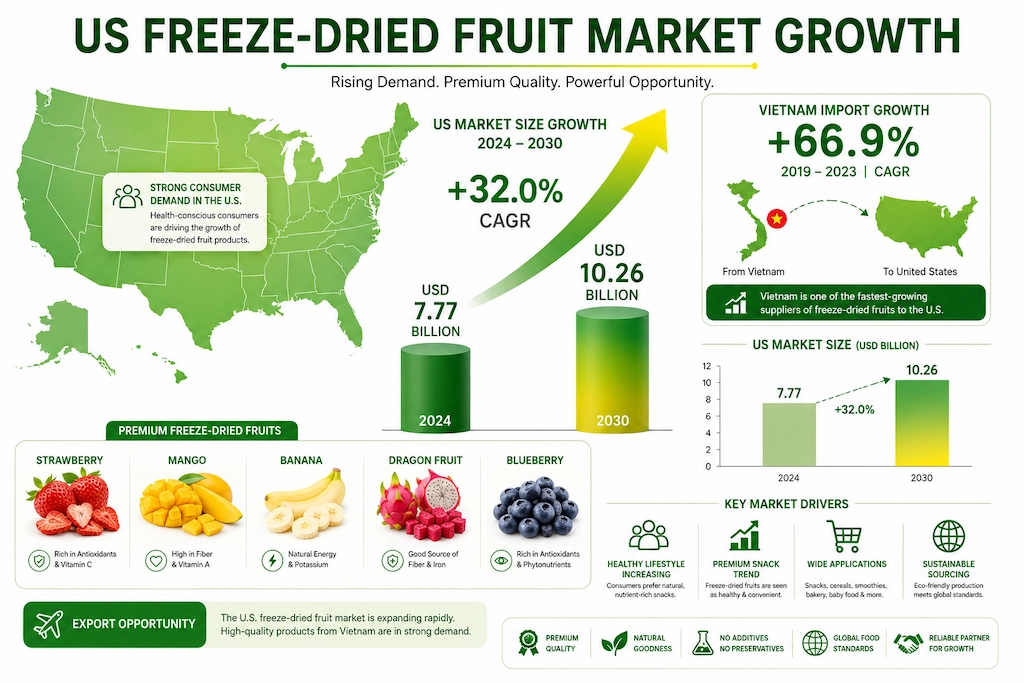
The United States is the world’s largest and most sophisticated market for freeze‑dried and soft‑dried fruits. The North America freeze‑dried fruits and vegetables market was valued at USD 7.77 billion in 2025 and is projected to grow to USD 10.26 billion by 2031, at a CAGR of 4.74%. The US alone accounts for 22.6% of the global freeze‑dried fruits and vegetables market and is expected to remain the largest contributor to global market size through 2034.
The broader US dried fruit market is equally impressive. The United States Dry Fruits Market is projected to grow from US3.62billionin2025toUS3.62billionin2025toUS 5.66 billion by 2034, at a CAGR of 5.09%. Imports of dried fruit (HS 081340) reached US$ 251.56 million in the 12 months to October 2025, marking a significant 23.31% year‑on‑year increase. This growth is driven by rising consumer demand for convenient, nutrient‑dense, clean‑label snacks, increasing plant‑based diets, and the extended shelf life that freeze‑dried products offer without chemical preservatives.
Vietnam’s Rapidly Growing Market Share
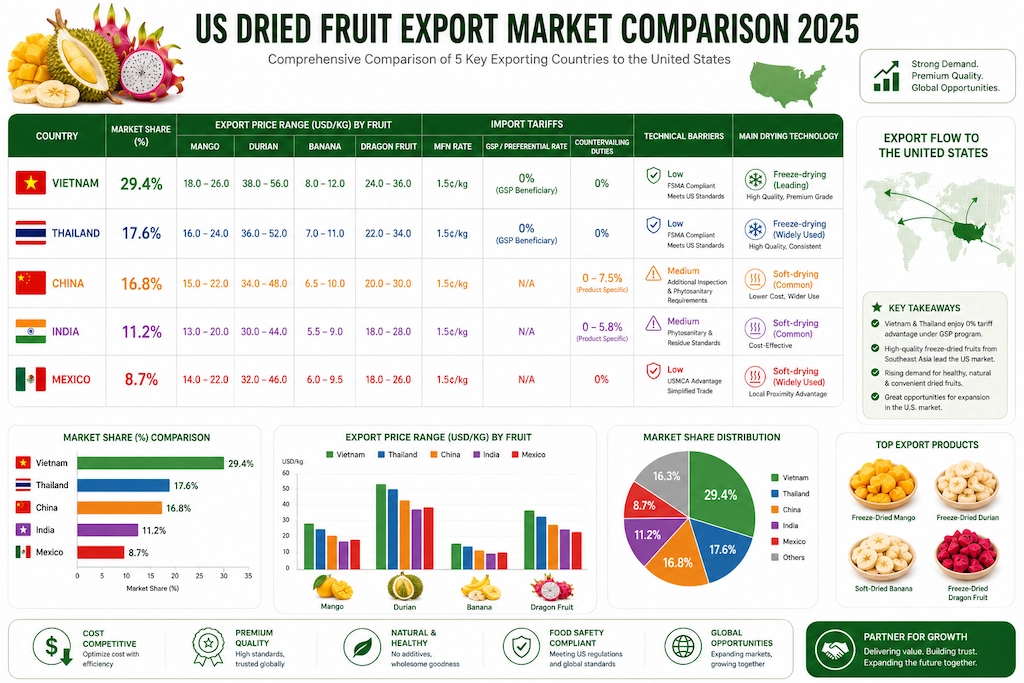
Vietnam is emerging as one of the fastest‑growing suppliers of dried fruit to the US market. In the same 12‑month period, Vietnam’s dried fruit exports to the US grew by 66.9% year‑on‑year, reaching US$ 28.78 million and capturing an 11.44% market share. This growth rate far exceeds the market average, positioning Vietnam as a key player alongside traditional suppliers like Egypt (35.78% share) and Turkey (10.32% share).
In the first nine months of 2025 alone, Vietnam’s total fruit and vegetable exports to the US reached **US407million∗∗,comparedtoUS407million∗∗,comparedtoUS 360 million for the full year 2024. US consumer trends are shifting toward novel fruits, health‑oriented products, and deeply processed items such as frozen fruit, dried fruits and juices, with Vietnamese products like coconut, durian and pomelo becoming increasingly popular.
US Regulatory Framework – The Four Pillars of Compliance
To successfully export freeze‑dried or soft‑dried fruits to the United States, suppliers must navigate four critical regulatory pillars.
- FDA Registration and Foreign Supplier Verification Program (FSVP)
All foreign food facilities must register with the US Food and Drug Administration (FDA). Additionally, US importers are required to implement a Foreign Supplier Verification Program (FSVP), which mandates that imported food meets the same safety standards as domestically produced food. This requires full traceability, documented food safety plans, and verification that foreign suppliers comply with US standards. Products must also be labeled with the country of origin (COOL) as required by the 2002 Farm Security and Rural Investment Act.
- Pesticide Residue Limits (MRLs) – EPA and FDA Enforcement
Pesticide residues in imported dried fruits are subject to strict limits set by the Environmental Protection Agency (EPA) and enforced by the FDA at the point of entry. The US operates a positive list system: only pesticides that have been approved for use on specific crops are permitted, and residues must not exceed established tolerances. Non‑compliant shipments can be detained without physical examination under FDA Import Alerts. The US has been tightening regulations on traceability and food safety, particularly with respect to pesticide residues. Vietnamese exporters must ensure their products comply with US MRLs, which often differ significantly from those in other markets.
- Sulphur Dioxide (SO₂) – A Critical Barrier
Sulphur dioxide (SO₂) is widely used in conventionally dried fruits to preserve colour and extend shelf life. However, the US FDA strictly regulates SO₂ levels. For dried fruit imports, the acceptable limit is effectively below 10 ppm (not detected) under the Optimized Monier‑Williams method. Excessive or undeclared SO₂ is a common reason for border rejections. US consumers and retailers increasingly seek SO₂‑free, clean‑label products, making this a critical competitive differentiator.
- Phytosanitary and Plant Inspection Standards
The Animal and Plant Health Inspection Service (APHIS) of the USDA requires phytosanitary certificates from the exporting country to confirm that shipments are free of plant pests and diseases. All batches must be inspected and certified before customs declaration; non‑compliant batches will be returned to the exporting country or destroyed. Additionally, customs can only grant import permits after inspections by both APHIS and FDA at the point of entry.
Tariff Structure and Trade Preferences
Understanding the US tariff structure is essential for competitive pricing.
Dried mango, for example, is classified under HTS 0804.50.80.10. The Most Favoured Nation (MFN) tariff rate is 1.5¢ per kilogram. However, Vietnamese‑origin dried mango can benefit from the Generalized System of Preferences (GSP, Program A), which grants a 0% tariff (duty‑free) at the US port of entry. To claim this preferential rate, exporters must provide a Certificate of Origin (GSP Form A).
This tariff advantage gives Vietnamese suppliers a significant cost edge over competitors from countries that do not enjoy GSP benefits. However, trade policy is dynamic; the US has been reviewing GSP eligibility, and potential tariff changes could affect competitiveness. The US also tightened regulations on Vietnamese imports in early 2026.
Barriers and Challenges for Vietnamese Exporters
Despite the opportunities, Vietnamese dried fruit exporters face several persistent challenges in the US market.
- Pesticide Residue Non‑Compliance
Many Vietnamese processors source from fragmented smallholder farms with inconsistent pesticide control. The US requires strict adherence to its MRLs, and non‑compliance leads to detention or rejection. Vietnam has been working to improve compliance, but this remains a significant hurdle.
- SO₂ Overuse
Conventional dried fruit production in Vietnam often relies on SO₂ for colour preservation. However, the US market increasingly rejects SO₂‑treated products due to health concerns and clean‑label demands. Many Vietnamese exporters struggle to produce SO₂‑free dried fruits that maintain visual appeal.
- Traceability and EUDR‑Style Pressures
While the EU Deforestation Regulation (EUDR) has not yet been adopted in the US, American buyers are increasingly demanding full supply chain traceability, farm‑to‑factory documentation, and environmental responsibility. Vietnamese exporters with fragmented supply chains find this challenging.
- Cold Chain and Quality Consistency
Maintaining consistent product quality from farm to container is difficult due to gaps in cold‑chain infrastructure in Vietnam. Variations in raw material quality, drying consistency, and moisture control can lead to rejected shipments.
- Rising Tariff and Trade Policy Uncertainty
The US has signalled potential tariff increases on Vietnamese goods. A proposed 20% tariff on Vietnamese agricultural products would raise costs and reduce competitiveness. Exporters must stay informed and build pricing strategies that can absorb tariff fluctuations.
- Competition from Established Suppliers
Vietnam competes with Egypt (35.78% market share), Turkey (10.32%), and other established suppliers. These countries have longer export histories, established buyer relationships, and in some cases, lower production costs.
How Hana Nguyen Transforms Barriers into Competitive Advantages
Hana Nguyen was founded with a clear mission: to produce premium dried fruits that meet the highest international standards. The company has built its production model around four core principles that directly address US market requirements.
Advantage 1: Zero SO₂, Clean‑Label Production
Unlike many conventional dried fruit processors, Hana Nguyen uses no sulphur dioxide as a preservative. The company’s freeze‑drying and low‑temperature cold‑drying processes rely entirely on physical dehydration to achieve shelf stability. This eliminates the risk of SO₂‑related border rejections and positions its products as clean‑label, meeting the preferences of US retailers and health‑conscious consumers. Every batch is tested to ensure SO₂ levels are below 10 ppm (not detected).
Advantage 2: Pesticide Compliance Through Integrated Farming
Hana Nguyen has established direct, long‑term partnerships with farming cooperatives across the Mekong Delta and Central Highlands. This integrated approach allows the company to control input usage, monitor pesticide application, and maintain rigorous MRL compliance before fruit ever reaches the processing line. Every batch is independently lab‑tested for pesticides, heavy metals, and contaminants – ensuring compliance with EPA and FDA requirements.
Advantage 3: Full Traceability and Supply Chain Transparency
Through its farm‑direct sourcing model, Hana Nguyen has built plot‑level traceability for key fruit varieties, including dragon fruit, mango, durian, longan, and sapodilla. This capability gives US buyers confidence in supply chain transparency and meets the increasing demand for documented origin and food safety.
Advantage 4: International Certifications – HACCP, FSSC 22000, FDA Registered
Hana Nguyen operates a facility that is HACCP, FSSC 22000, and FDA registered. The company’s FDA registration ensures compliance with US food safety regulations. Every shipment includes a full Certificate of Analysis (COA) covering moisture, water activity, microbiology, and SO₂‑free status – documentation that US importers routinely require.
Advantage 5: Advanced Drying Technologies for Premium Quality
Hana Nguyen has invested in three complementary drying platforms:
- Freeze Drying – Preserves >95% of nutrients, colour, and shape; produces crispy, lightweight, shelf‑stable fruit with a 24‑month lifespan. The global freeze‑dried fruits and vegetables market is growing at a CAGR of 6.66%.
- Soft Drying (Cold Drying) – Low‑temperature air drying at 55‑65°C produces chewy, vibrant, naturally coloured fruit without caramelisation or added sugar.
- Cold Dried Powders – Gently dried and finely milled to produce natural food colours and functional ingredients (beetroot, carrot, ube, purple sweet potato, green banana).
These technologies allow Hana Nguyen to produce products that not only meet US regulatory requirements but exceed buyer expectations for sensory quality.
Advantage 6: GSP Tariff Advantage – Duty‑Free Access
Hana Nguyen’s products are eligible for 0% tariff under the US Generalized System of Preferences (GSP). This gives US importers a significant cost advantage compared to suppliers from countries without GSP benefits. Hana Nguyen provides full GSP documentation, including Certificate of Origin (GSP Form A), enabling buyers to claim the duty‑free rate.
Advantage 7: Direct Factory – No Brokers, Full Transparency
Hana Nguyen’s B2B export model is based on factory‑direct pricing, transparent FOB quotations, and full supply chain visibility. US importers can request free samples, receive pre‑shipment COAs, and audit the facility directly – building trust through direct engagement.
US Market Segments for Freeze‑Dried and Soft‑Dried Fruits
Freeze‑Dried Fruits
- Premium ready‑to‑eat snacks (pouches, tins, gift boxes)
- Breakfast cereal and granola inclusions
- Chocolate and confectionery pieces
- Smoothie bowl toppings and beverage powders
- Natural food colouring and flavouring ingredients
- Baby food and functional nutrition products
Soft‑Dried Fruits (Cold Dried)
- Chewy standalone snacks (retail pouches)
- Trail mixes and nut blends
- Bakery fillings (muffins, breads, scones, fruit cakes)
- Yogurt, ice cream, and dairy toppings
- Confectionery (dipped or coated fruit)
Cold‑Dried Powders
- Natural food colours for bakery, confectionery, and beverages
- Functional ingredients for smoothies, protein shakes, and baby food
- Gluten‑free baking (green banana powder)
Frequently Asked Questions (B2B – US Focus)
- Are Hana Nguyen’s dried fruits FDA‑compliant?
Yes. Hana Nguyen’s facility is FDA registered, and every batch is tested to meet US food safety standards. Full COA documentation (moisture, Aw, microbiology, SO₂‑free) is provided with every shipment. - How does Hana Nguyen ensure pesticide residues meet US MRLs?
Through integrated farming partnerships and pre‑harvest testing. Each batch is independently lab‑tested against US EPA and FDA requirements. The facility maintains full traceability from farm to finished product. - Does Hana Nguyen use SO₂ in its dried fruits?
No. Hana Nguyen uses no sulphur dioxide in its freeze‑dried or cold‑dried products. Soft‑dried fruits can be supplied completely SO₂‑free upon request. Every batch is tested to ensure SO₂ levels are below 10 ppm (not detected). - What is the GSP tariff benefit for US importers?
Vietnamese‑origin dried fruit is eligible for 0% tariffunder the US GSP program (Program A). To claim this benefit, Hana Nguyen provides a Certificate of Origin (GSP Form A). - What certifications does Hana Nguyen hold?
HACCP, FSSC 22000, and FDA registration. All certifications are available for buyer review during the audit process. - Can Hana Nguyen produce private label / OEM products for US brands?
Absolutely. Private label and OEM orders are available for container quantities. Hana Nguyen can print retail pouches, cartons, and labels according to buyer specifications. - What is the MOQ for container orders to the US?
One 20ft container (≈5‑8 tonnes depending on product). Trial orders of 500‑1,000 kg are available at a higher per‑kg rate. - Can I get a free sample before placing an order?
Yes. Hana Nguyen provides a free 100‑200g sample (buyer pays international shipping). The sample is produced using the same process as bulk orders and includes a preliminary COA. - What documentation is provided for US customs clearance?
Commercial invoice, packing list, Bill of Lading, phytosanitary certificate, COA (moisture, Aw, microbiology, SO₂‑free), and FDA prior notice confirmation. For GSP claims, a Certificate of Origin (GSP Form A) is also provided. - What payment terms are accepted?
30% deposit T/T, 70% against copy of Bill of Lading. L/C at sight for long‑term contracts (≥6 months). - What is the typical lead time to US ports?
Production: 7‑10 days after deposit. Sea freight from Cat Lai Port, Ho Chi Minh City, to US West Coast (Los Angeles, Long Beach, Oakland): 18‑22 days. Total: 45‑60 days including customs clearance.
12. How should freeze‑dried and soft‑dried fruits be stored in US warehouses?
Unopened bags can be kept at room temperature (≤25°C, <60% RH). Once opened, reseal tightly and consume within 30 days to maintain quality. Do not refrigerate – condensation will soften the product.